The Most Common Reason People Stall on Their Estate Plan
I have had more conversations than I can count that go something like this: a couple has three children, they want a trust, they understand why they need one — and then the process stalls. Not because of cost. Not because the documents are complicated. Because they cannot bring themselves to name one child as successor trustee and not the others.
The concern is not irrational. The successor trustee has real power: they control the timing of distributions, manage investments, file accountings, and make judgment calls that affect every beneficiary. Naming one sibling over another sends a message — whether you intend it to or not. And the sibling who was passed over notices.
But here is the thing: leaving your family without a trust because you cannot choose a trustee causes far more damage than any trustee choice you could make. When there is no trust, there is no framework, no clear authority, and no written expression of your wishes. That is the real recipe for a family rift.
The good news: your children are not your only options.
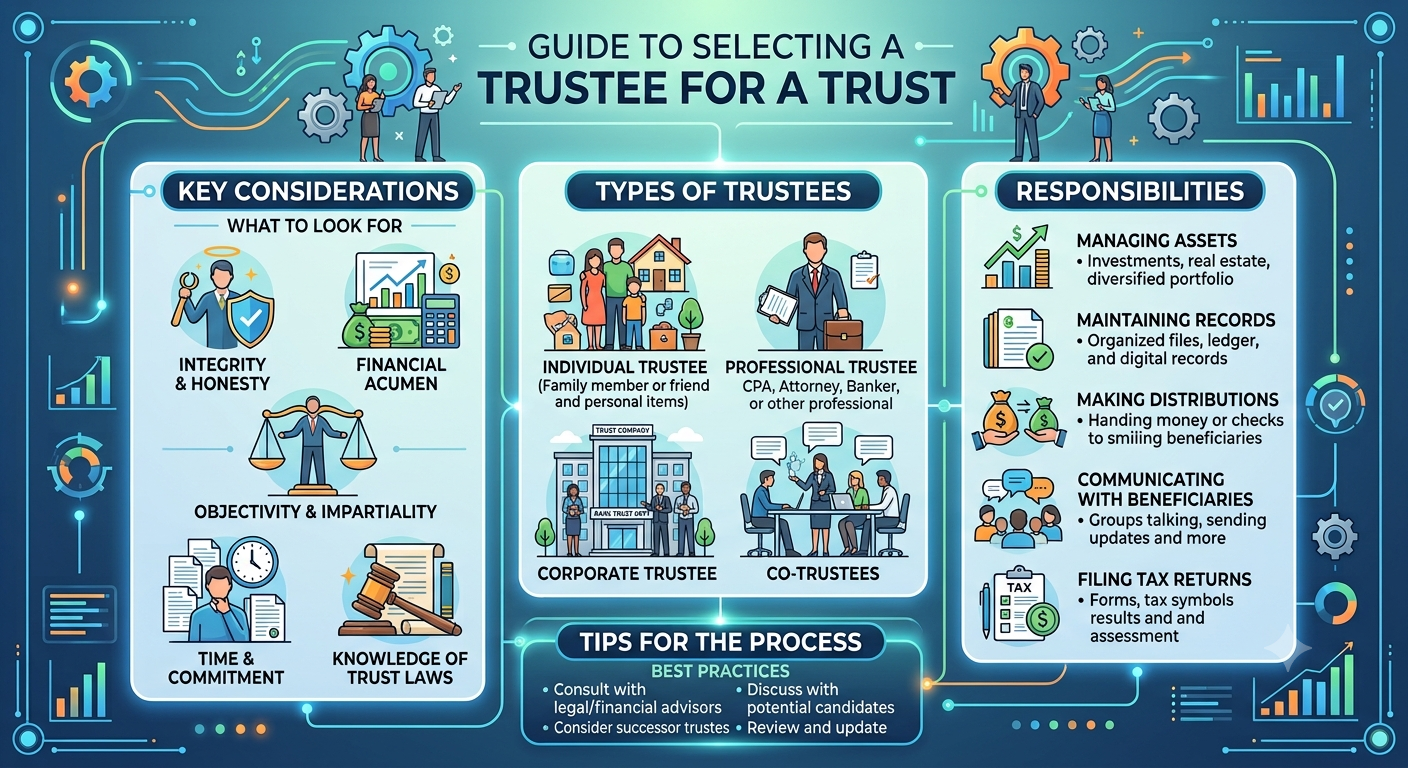
Option 1: A Professional or Corporate Trustee
Bank trust departments and independent trust companies
A professional corporate trustee is an institution — a bank's trust department or an independent trust company — that administers trusts as its core business. They have investment professionals, compliance teams, and established processes for distributions, accountings, and tax filings.
The neutrality is the point. No child can accuse a bank of playing favorites. Distributions happen according to the trust's terms, not family politics. The trustee has no emotional stake in the outcome.
Strengths
- Completely neutral — no family allegiances
- Investment and administrative expertise
- Institutional continuity — they will still be there in 30 years
- Bonded and regulated
Considerations
- Annual fees (typically 0.5%–1.5% of assets)
- Minimum asset thresholds at some institutions
- May not know your family or your beneficiaries personally
- Less flexibility on discretionary decisions
A corporate trustee works best when the trust holds significant assets, when the family dynamics are genuinely difficult, or when there is no suitable individual in your life who could serve. For smaller trusts, the annual fee may represent a meaningful drag on the estate — which is worth weighing against the conflict it prevents.
Option 2: An Independent Individual Trustee
A CPA, attorney, financial advisor, or trusted non-family friend
An independent individual trustee is a person — not a family member and not a beneficiary — who serves in a professional or quasi-professional capacity. This might be your longtime CPA, your financial advisor, a trusted family friend with financial acumen, or an attorney who handles trust administration.
Unlike a corporate trustee, an independent individual typically knows your family. They understand the context behind your decisions, can exercise genuinely human judgment on discretionary distributions, and often cost less than an institutional trustee for simpler trusts.
Strengths
- Neutral — not a beneficiary, no personal stake
- Knows your family and your intentions
- Often more flexible and responsive than an institution
- Potentially lower cost for smaller or simpler trusts
Considerations
- Individual mortality — you need a successor to your trustee
- May lack investment expertise without help
- Should be someone willing to accept fiduciary liability
- Friendship can complicate accountability
Option 3: Co-Trustees
Naming multiple trustees to serve together
Co-trusteeship is appealing in theory: everyone is included, no one is singled out, and the decision gets distributed. In practice, it requires careful thought before you commit to it.
Unless the trust document specifies otherwise, co-trustees must act unanimously. A single disagreement — about the timing of a distribution, whether to sell an asset, how to handle a beneficiary's request — can bring administration to a standstill. Courts can break deadlocks, but that means legal fees and exactly the kind of conflict you were trying to avoid.
Strengths
- No single child is elevated above the others
- Built-in checks — each trustee watches the others
- Can combine complementary skills (one financially savvy, one locally present)
Considerations
- Unanimity requirement can paralyze administration
- Amplifies existing sibling conflict rather than resolving it
- Logistics become complex when co-trustees live in different states
- All trustees share fiduciary liability
Co-trusteeship works when your children genuinely communicate well and make decisions together without friction. If they already struggle with that, giving them joint control of your estate is unlikely to improve things. A safer version: name one child as primary trustee with another as a required co-signer only for major decisions above a certain dollar threshold.
Option 4: Split the Roles
One of the most underused tools in trust planning is separating the administrative trustee role from the discretionary distribution role. The two functions are quite different, and there is no rule requiring the same person to perform both.
You might name a child — or a professional — as the administrative trustee, responsible for investment management, record-keeping, tax filings, and routine distributions. Then you appoint a trust protector to oversee discretionary decisions: whether to make a large distribution for a beneficiary's education, how to handle a request for early access to principal, or whether to modify a distribution schedule as circumstances change.
This structure gives the trustee operational efficiency while placing the most sensitive decisions — the ones most likely to generate resentment — in the hands of a neutral party.
The Trust Protector: An Independent Oversight Layer
A trust protector is a person or institution named in the trust document with specific powers to oversee the trustee, without managing the assets day-to-day. Common trust protector powers include:
- The ability to remove and replace the trustee
- Approval authority for discretionary principal distributions above a threshold
- The power to resolve disputes between a trustee and beneficiaries
- The ability to modify administrative provisions if the law changes
A trust protector is particularly useful when you name a family member as trustee but want an independent check on their decisions. The trustee handles the day-to-day administration; the trust protector watches the trustee. Beneficiaries who disagree with a trustee decision have somewhere to go besides a courthouse.
The structure most parents overlook: Name a child as administrative trustee (they handle the paperwork and routine distributions), and name an independent individual or institution as trust protector with authority over discretionary distributions and the power to replace the trustee. This separates the task most children can handle from the decisions most likely to generate conflict.
How the Trust Document Itself Reduces Conflict
Here is something worth understanding: the less discretion the trustee has, the less potential there is for conflict — regardless of who serves.
A trust that says "distribute all net income quarterly to my children in equal shares, and distribute principal only for health, education, maintenance, and support, as the trustee determines in their sole discretion" gives the trustee significant room to make judgment calls that beneficiaries can challenge. A trust with clearer distribution standards — specific formulas, defined triggering events, limited trustee discretion — reduces the number of decisions that can become flash points.
When I draft a trust for a family with complicated dynamics, I pay close attention to the distribution provisions. Clear standards protect the trustee from accusations of favoritism and protect beneficiaries from a trustee who might be tempted to misuse discretion. The document itself is part of the conflict-prevention strategy.
Before You Decide: Questions Worth Asking
Whatever direction you are leaning, these questions help clarify the choice:
- Who do my children respect? A trustee who commands natural respect from all beneficiaries encounters less resistance, regardless of their formal authority.
- Who is organized and financially literate? Trustee work is administrative — tax filings, investment oversight, accountings, correspondence. These tasks require attention to detail, not just good intentions.
- Who lives nearby? Proximity matters for managing real property, attending to local matters, and staying engaged with beneficiaries who may need in-person support.
- Have you asked them? Many people name a trustee without ever discussing it with that person. A trustee who is surprised by the role — and unprepared for the responsibility — is not in a position to serve well.
- Does the trust document support them? A good trustee with a poorly drafted trust is set up to fail. Clear distribution standards and a well-structured document make any trustee's job easier.
And one more: whatever you decide today does not have to be permanent. A revocable living trust can be amended while you are living and have capacity. If a child matures, a relationship changes, or a better option presents itself, you can update your successor trustee designation without rewriting the entire document.
Frequently Asked Questions
-
Yes, but proceed with caution. Co-trustees must act unanimously unless the trust document specifies otherwise, which means a single disagreement can paralyze administration. If your children already communicate and make decisions well together, co-trusteeship can work. If they don't, it often amplifies existing tensions rather than resolving them. A better alternative in many cases is naming an independent trustee with a trust protector role for oversight.
-
Corporate trustees typically charge an annual fee of 0.5% to 1.5% of trust assets, often with a minimum annual fee. Fees vary by institution, the complexity of the trust, and the services required. For smaller trusts, the minimum fee may represent a significant percentage of assets. An independent individual trustee generally charges hourly or a flat annual fee, which may be lower for simpler trusts.
-
A trust protector is a person or institution named in the trust document with specific powers to oversee the trustee — typically the ability to remove and replace the trustee, resolve disputes, or approve certain distributions. The trust protector is not the trustee and does not manage the assets day-to-day. They serve as an independent check on the trustee's conduct, which can be valuable when family dynamics make oversight important.
-
Yes. A revocable living trust can be amended at any time while you are living and have capacity. If your circumstances change — a child matures, a relationship shifts, a professional trustee becomes available — you can update your successor trustee designation through a trust amendment. You do not need to rewrite the entire trust document.
-
No. The trustee's role is administrative — they manage and distribute the assets according to the trust's terms. The trustee does not receive a larger share of the estate simply by virtue of serving as trustee. They may be entitled to reasonable compensation for their work, but that compensation comes from the trust, not from another beneficiary's share. The distribution of the estate is governed by the trust document itself, not by who serves as trustee.